
Global timing belts market keeps steady growth amid automation expansion
The global automotive timing belt market reached USD 7.7 billion in 2025. Industry analysts forecast a 4.8% CAGR for the wider timing belt market to 2030. Rising automation demand fuels consistent demand across many manufacturing sectors. Packaging, textile, CNC and robotic equipment all rely on synchronous belt drives. Buyers now focus less on single parts and more on complete transmission system stability.
Core definition: timing belts deliver slip-free synchronized motion
A timing belt is a toothed synchronous power transmission component. Belt teeth lock into pulley grooves to maintain precise motion alignment. This positive engagement avoids slip common with flat belts or friction rollers. Even small mismatches can trigger noise, positioning drift or unexpected downtime. Many machine failures stem from poor system matching instead of defective belts.
Three mainstream timing belts families with distinct material structures
Rubber timing belts use neoprene bodies and fiberglass tensile cords. Their typical hardness sits at 92 Shore A for balanced flexibility and strength. Common metric profiles include HTD 5M, 8M, 14M and STD S3M, S5M, S8M. This range suits general automation, conveyors and standard packaging lines.
PU timing belts combine polyurethane bodies and steel cord reinforcement. They feature better oil resistance and cleaner running conditions than rubber types. T5, T10, AT5 and AT10 are widely used precision PU tooth profiles. AT10 models can handle transmission loads up to 70 kW in heavy positioning tasks.
Carbon composite timing belts target high-speed servo motion control. The 8MGT variant uses polyurethane, carbon fiber cords and nylon tooth fabric. Transmission efficiency can hit 98% with a top belt speed of 80 m per second. This design runs maintenance-free and requires no extra lubrication.
Timing pulleys act as the matched half of every synchronous drive
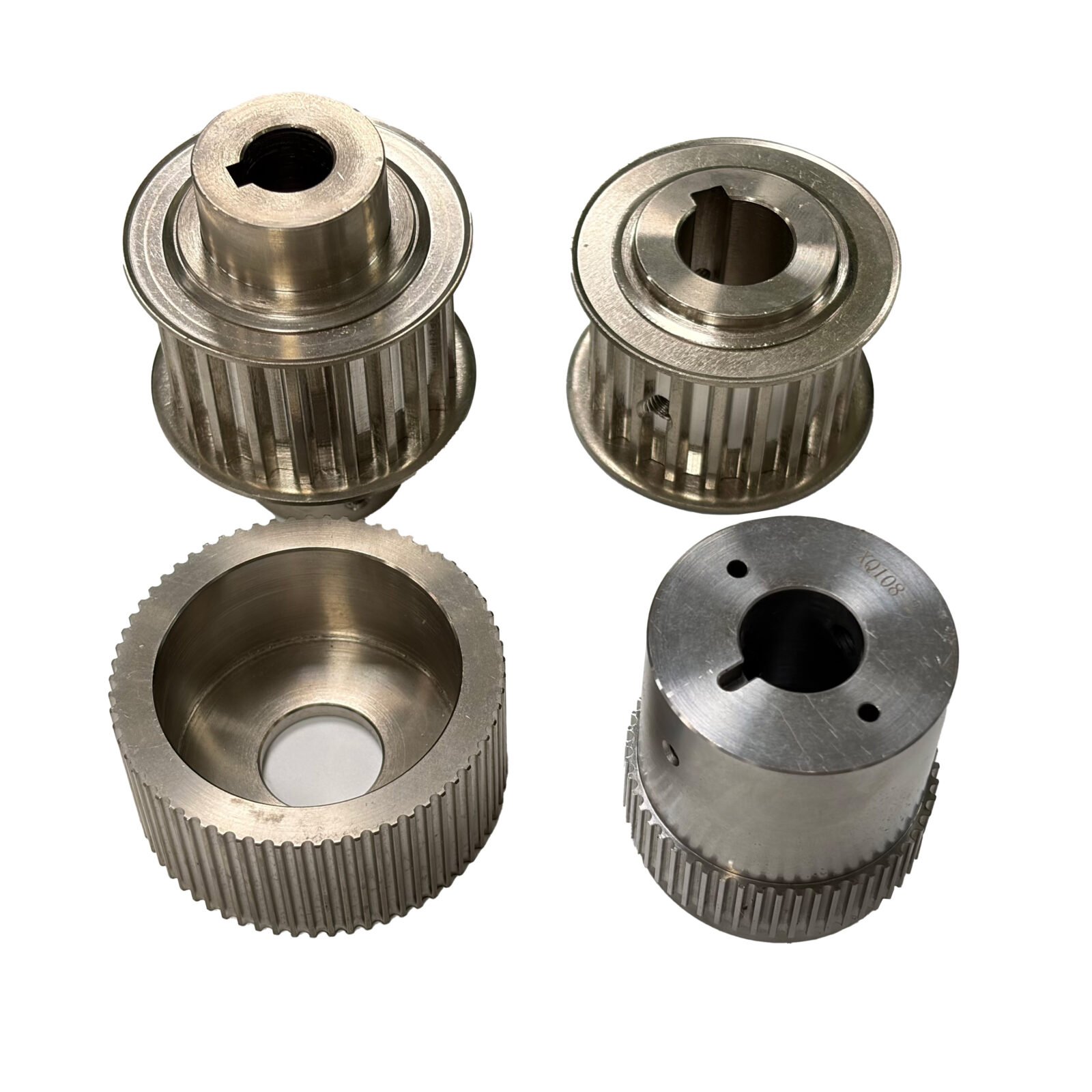
Pulley tooth profile must fully match the selected timing belts profile. Available pulley series cover imperial MXL, XL, L, H and metric T, HTD ranges. Raw material choices include aluminum alloy, carbon steel and stainless steel. Bore styles cover pilot bore, finished bore, taper bore and keyway bore. Surface treatments include black oxide, zinc plating and hard anodizing. CNC machining and gear hobbing control tooth accuracy and concentricity. High-precision pulleys keep radial runout within 0.03 mm for stable positioning.
Practical seven-step workflow for reliable timing belts selection
Start selection by recording all real operating conditions of the machine. Note motor power, rotation speed, temperature and exposure to oil or dust. Second, confirm tooth pitch and profile when replacing existing transmission sets. Wrong tooth shapes cannot mesh correctly even if belt length appears similar. Third, pick belt material and tensile member based on working environment. Fourth, define belt width and pitch length while checking published tolerances. Standard tolerance values are ±0.5 mm width and ±0.5 mm length for most belts. HTD 14M belts apply a wider width tolerance of ±1.0 mm for heavy loads. Fifth, verify pulley teeth count, hub style, flange and finished bore tolerance. Sixth, cross-check compliance with ISO 13050:2022 and relevant DIN standards. Seventh, audit manufacturer capacity, inspection process and stock availability.
Standard compliance and quality inspection reduce operational risk
ISO 13050:2022 governs metric curvilinear synchronous belts and pulleys. Imperial timing drive components follow RMA, ISO and DIN specifications. Rigorous dimensional inspection before shipment is a key quality checkpoint. Controlled concentricity and tooth accuracy prevent gradual positioning drift. Quality control matters more for servo axes and high-repeatability processing.
Application mapping links belt types to typical industrial equipment
HTD 8M rubber belts serve sealing stations and synchronized product conveyors. PU T5 and AT5 belts fit printing, labeling and textile machinery lines. 8MGT carbon composite belts support high-speed CNC and robotic servo axes. HTD 14M rubber belts carry heavy loads on large material handling conveyors. Each use case prioritizes different targets: speed, load, precision or chemical resistance.
Final buying takeaway: treat timing drive as one integrated system
Buyers should define application requirements before comparing brand options. Profile, material, pulley machining and tolerance work together as a set. A full-line supplier with in-house machining simplifies custom pulley orders. Ready stock cuts lead time for standard replacement parts on production lines. Custom drawings for special bores or gears need confirmed lead time before ordering. System-first selection lowers unplanned downtime and improves long-term ROI.