
Industrial Buyers Need Verified Timing Belt Suppliers, Not Just Catalog Parts
Industrial automation buyers cannot rely only on catalog numbers for timing belts. These precision parts control shaft synchronization in packaging and handling machines. Poor belt matching triggers positioning errors, vibration and unexpected equipment failure. Today’s procurement teams prioritize traceable materials and audited factory processes. Many buyers struggle to validate supplier claims before issuing formal purchase orders. The global timing belt market keeps growing with strong demand from industrial OEMs. China holds the largest regional share in the automotive timing belt segment worldwide. Global brands and local Chinese manufacturers both serve international industrial customers. Regional manufacturers offer flexible custom sizes and low-volume OEM production options.
Key Tooth Profiles and Pitch Rules for Industrial Timing Belt Selection
Tooth profile defines how a timing belt meshes with its paired timing pulley. Trapezoidal profiles include T2.5, T5, T10, T20 and reinforced AT5, AT10 types. Curvilinear HTD options cover 3M, 5M, 8M, 14M for heavy synchronous transmission. STD and STS profiles such as S3M, S5M, S8M suit compact precision motion systems. Imperial profiles like MXL, XL, L and H fit legacy North American machine designs. Every profile uses a fixed pitch measured in millimeters or inches. Wrong pitch causes tooth skipping and full loss of drive synchronization during operation. Engineers must confirm pitch before selecting any belt for servo or conveyor equipment.
Rubber vs PU Timing Belt: Material Choices Change Operating Limits
Rubber timing belts usually use neoprene body and fiberglass tensile cords. They deliver balanced wear resistance for medium and heavy industrial drive tasks. Standard rubber belt hardness sits around 92 Shore A for stable long runs. Polyurethane timing belts adopt steel or carbon fiber tensile members. PU belts resist oil, chemicals and ozone better than traditional rubber belts. They maintain stable dimensions for food machinery and precision linear motion. Carbon fiber PU belts support ultra-high speed up to 80 meters per second. Transmission efficiency of carbon PU timing belts can reach 98 percent. Rubber belts fail quickly under heavy oil or extreme temperature conditions.
Critical Dimensional Tolerances for Precision Timing Belt Projects
Precision timing belts must follow strict dimensional tolerance ranges. Belt width tolerance normally stays within plus or minus 0.5 millimeters. Overall length also holds a tolerance of ±0.5 mm for standard industrial belts. Thickness tolerance is ±0.2 mm for most common timing belt profiles. Small T5 belts tighten thickness tolerance down to ±0.15 millimeters. These tight controls matter for fixed pulley center distance setups. Multiple belts running on one shared drive system need matched dimensions. Buyers should cross-check tolerance data on supplier technical data sheets.
Compliance Certifications: Product Tests and Independent Factory Audits
Valid certifications separate qualified timing belt makers from unregulated suppliers. RoHS test reports prove products meet EU restricted substance requirements. Dongguan Zhende Machinery holds SGS RoHS test report for FA transmission parts. This SGS certificate covers HTD 8M rubber timing belts for EU export sales. TÜV Rheinland factory audits verify production and quality control workflows. Zhende’s TÜV audit covers timing belt and timing pulley manufacturing processes. ISO 13050:2022 sets standards for metric curvilinear synchronous belts and pulleys. ISO 9563 and ISO 1813 apply to belts working inside explosive environments. Factory audits check process control, not guarantee the full product performance. RoHS compliance only controls hazardous substances, not mechanical service life.
Step-by-Step Supplier Evaluation Workflow for Timing Belt Procurement
Buyers start by defining full operating conditions for their timing belt application. Record tooth profile, pitch, load, speed, temperature and chemical exposure levels. Source manufacturers that produce both timing belts and matching timing pulleys. One-source suppliers reduce mismatch risks between belt tooth and pulley grooves. Request original certificates and validate certificate numbers and expiry dates. Review material data, tensile strength, hardness and dimensional tolerances. Ask suppliers for full inspection procedures before order confirmation. Quality-focused factories complete 100% dimensional checks before shipment. Check commercial terms including MOQ, lead time and after-sales support policies. Order samples for bench testing before launching mass production orders. Sample testing confirms fit and real performance on actual machine systems.
Matching Belts and Pulleys for Different Industrial Applications
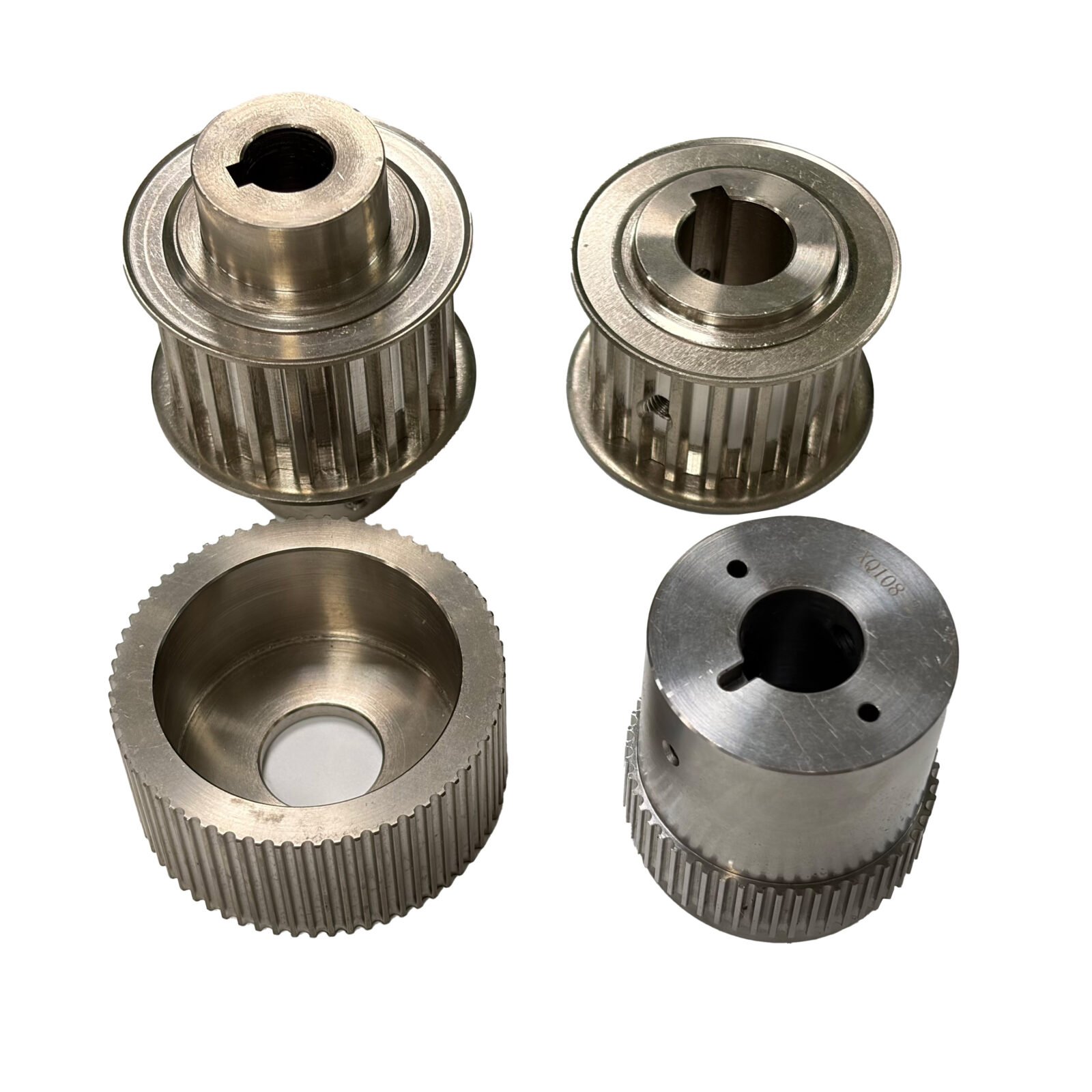
Packaging and automation machines favor PU belts for precise servo positioning. T5 PU timing belts fit packaging lines with stable dimension and low elongation. AT10 PU belts support up to 70 kW power for heavy conveyor and machine tool use. HTD 14M rubber timing belts handle high torque for mining and construction gear. Carbon fiber PU belts serve robotics and high-performance packaging equipment. Timing pulleys must match belt profile, bore size and installation requirements. Aluminum, steel, stainless and cast iron pulley materials cover diverse loads. CNC machined pulleys achieve concentricity below or equal to 0.03 millimeters. Surface treatments include anodizing, black oxide, zinc and nickel plating options. T-series pulleys match trapezoidal belts while imperial pulleys suit old US machines.
Real Export Case Data Shows Stable Long-Term OEM Supply Performance
Zhende Machinery maintains repeat export orders in Germany and the United States. One German OEM bought 8,500 timing pulleys over five continuous years. A US industrial distributor purchased 15,000 pulleys within three years. These projects lifted transmission accuracy by 25 percent for end users. Maintenance costs dropped by 40 percent after switching to certified parts. Equipment downtime reduced by 30 percent with qualified timing drive systems. The factory also shipped 12,000 belts to Germany and 20,000 belts to the US. Reported belt transmission efficiency reached 98 percent in field operation. Buyers treat these results as supplier-reported operational benchmarks. Multi-year export orders prove consistent mass production capacity overseas.
Common Sourcing Risks Industrial Buyers Must Recognize
Material compatibility limits define where rubber or PU belts can operate safely. Each timing belt profile has a hard minimum pulley diameter requirement. HTD 8M belts need minimum pulley diameter of 40 millimeters for safe use. HTD 14M belts require a minimum pulley size of 124.78 millimeters. Running below this threshold accelerates fatigue and shortens belt service life. Maximum operating speed varies by tensile cord and belt body material type. Certificates show compliance status but do not act as unlimited product warranty. Buyers should plan third-party inspection for high-risk industrial applications. Quality sampling helps verify whether shipped parts match specification sheets.
Final Takeaways for Industrial Timing Belt Procurement Teams
Separate marketing claims from verifiable engineering data during supplier review. Confirm material specs, standards alignment and inspection rules with documents. Check customization flexibility, minimum order quantity and production lead time. Use factory audits and sample testing to validate real component performance. Qualified manufacturers can answer compliance questions with official records. Zhende Machinery provides a downloadable brochure covering all FA motion parts. The brochure includes timing belts, pulleys, couplings and linear motion items. Industrial buyers can request this PDF for full capability and spec review. Smart sourcing cuts downtime and lowers long-term maintenance spending. Focus on verified compliance to avoid costly synchronous drive system failures.