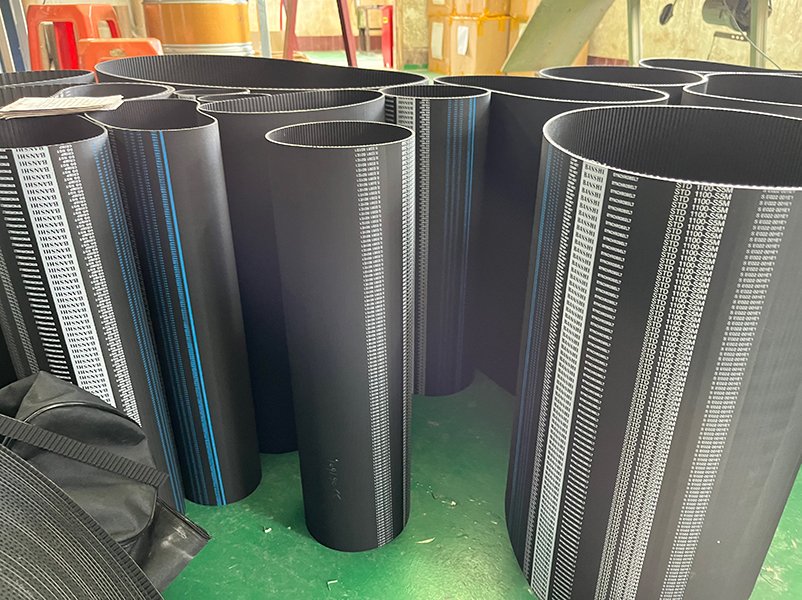
Global Industrial Buyers Face Timing Belt Qualification Challenges
Timing belt procurement is a qualification task, not simple commodity purchasing. Synchronization failure creates expensive downtime for automated production lines. Buyers across Europe and North America search for compliant custom timing belts. Many industrial teams struggle to verify factory capacity and material traceability. The worldwide timing belt market grows at a 4.8 percent CAGR through 2030. Major global belt brands share the market with capable Chinese manufacturers. Chinese manufacturers serve custom OEM projects with flexible low minimum orders. Export-focused factories build documentation for EU and US industrial standards. Buyers need clear checklists to filter reliable timing belt and pulley suppliers.
Timing Belt Material and Tensile Member Selection Guide
Two main body materials dominate industrial synchronous belt production today. Neoprene rubber timing belts use fiberglass cords as the tensile load carrier. This design balances wear performance for medium and heavy-duty drive systems. PU timing belts use steel cords or carbon fiber cords for premium performance. PU construction delivers stronger resistance to oil, ozone and chemical splashes. Carbon fiber tensile cords enable high belt speed and excellent dimensional stability. HTD 8M rubber belt uses neoprene body with 8 mm pitch and 5.6 mm thickness. HTD 14M rubber belt has 14 mm pitch and 10 mm thickness for heavy torque loads. AT10 PU belts can handle up to 1700 N tensile strength per 10 mm belt width. Material selection starts from the machine’s real working environment conditions.
Mechanical Strength Ratings Help Engineers Build Safe Drive Systems
Maximum allowable tensile strength defines safe continuous operating load limits. Ultimate tensile strength shows the breaking point for each timing belt design. HTD 5M rubber belt reaches 650 N allowable strength per 10 mm belt width. Its ultimate tensile strength rating sits at 2600 N for destructive reference. HTD 8M rubber belt offers 780 N allowable strength and 3120 N ultimate strength. HTD 14M rubber belt reaches 1816 N allowable and 8308 N ultimate tensile load. AT10 PU timing belts deliver power transmission capacity up to 70 kilowatts. Design engineers use these figures to set enough safety margin for operation. Under-sizing tensile rating leads to sudden belt breakage during peak machine load. All mechanical data should come from validated supplier technical specification sheets.
Manufacturer Profile and Export Background as Qualification Signals
Dongguan Zhende Machinery Equipment Co., Ltd. specializes in FA transmission parts. The factory locates in Dalang Town, Dongguan city in Guangdong province. Founded in 2019, it runs a 4,500 square meter production workshop. Forty staff members work onsite including six dedicated mechanical engineers. Annual total output reaches 120,000 pieces of timing drive components. Around 75 percent of finished goods export to EU and US industrial customers. The engineering team supports technical discussion and custom drawing reviews. Export experience means the team prepares full test reports and compliance files. This background reduces communication risk for overseas OEM procurement teams. Buyers prioritize manufacturers with proven multi-year export track records.
OEM and ODM Customization Options, MOQ and Production Lead Time
Custom timing belt and pulley demands rise for automation and special machinery. Zhende Machinery offers full OEM and ODM development for timing transmission sets. Custom choices include material, tooth profile, pitch, tooth count and bore diameter. Buyers can add keyways, flanges, surface treatments and laser logo engraving. Monthly custom belt production capacity reaches 500,000 pieces per month. Custom timing belt minimum order quantity starts at only four pieces per order. Custom pulleys have MOQ of 50 pieces while standard pulleys start at ten pieces. Production lead time ranges from seven to twenty working days for most orders. Lead time changes based on product complexity and current factory load levels. Low MOQ supports prototype testing and small spare part stock replenishment. Fast turnaround helps OEMs shorten new machine development cycles greatly.
In-house Quality Control and Pre-Shipment Inspection Rules
Reliable timing belt factories implement multi-stage quality inspection workflows. Zhende Machinery carries out 100% dimensional inspection for all finished belts. Each batch passes tensile strength testing and tooth profile checking before shipping. Timing pulleys receive full bore dimension and tooth profile inspection as well. Pulleys go through concentricity testing and final pre-shipment quality checks. Finished pulley bore tolerance meets H7 standard for precision assembly work. Radial runout of finished pulleys stays within 0.03 millimeters maximum value. Qualified pulleys support maximum operating speed up to 8,000 revolutions per minute. Buyers may request full inspection procedure documents for internal audit use. Third-party SGS inspection can be arranged before shipment for critical orders. Sampling incoming goods helps industrial buyers validate supplier quality promises.
Application Matching: Pick Timing Belts Based on Machine Use Case
Industrial automation and packaging machines need accurate positioning control. PU timing belts fit servo systems due to low elongation and stable dimensions. T5 PU belts serve packaging machinery with 5 mm pitch and steel tensile cords. Heavy-duty transmission systems select HTD rubber belts for high torque output. HTD 14M rubber belts work well on large conveyors and construction equipment. High-speed robotics select carbon fiber PU timing belts for maintenance-free use. 8MGT Polychain carbon belt runs up to 80 m/s across -54°C to +85°C temperature. No lubrication is needed for carbon PU timing belt operation in servo drives. Timing pulley selection must match belt profile, material and assembly method. Aluminum pulleys suit light load, while steel or cast iron works for heavy torque. Surface protection options prevent rust and wear in humid or dusty workshops.
FAQ: Key Questions Global Timing Belt Buyers Often Ask
What does ISO-certified timing belt manufacturer mean in practice?
ISO certification means the factory follows standardized quality management rules. ISO 13050:2022 defines metric curvilinear synchronous belt and pulley features. Zhende timing pulleys follow ISO 13050 and DIN standards for tooth accuracy.
What compliance documents should a timing belt supplier provide?
At minimum, buyers need RoHS substance test reports and factory audit records. TÜV Rheinland factory audit confirms stable production and quality processes. Validate certificate ID numbers and expiry dates directly with issuing bodies.
Can manufacturers support custom timing belts with small order volume?
Yes, qualified factories accept custom belt orders starting from four pieces. Custom pulleys usually require higher MOQ compared to standard pulley models.
What lead time should buyers expect for custom timing belt production?
7 to 20 working days is typical, subject to specs and current factory workload. Confirm lead time formally in your quotation before releasing purchase orders.
How do rubber and PU timing belts differ for industrial drive designs?
Rubber belts deliver solid wear resistance for medium and heavy torque jobs. PU belts resist oil and chemicals better for precision and high-speed motion. Carbon fiber PU belts achieve top speed and high transmission efficiency rates.
Strategic Sourcing Tips to Reduce Timing Drive System Failures
Start every sourcing project by documenting full machine operating parameters. Shortlist manufacturers that produce both timing belts and matching pulleys. Mixed-source suppliers increase tooth profile mismatch risk for drive systems. Always collect and verify compliance certificates before vendor approval. Compare technical data sheets against your mechanical design requirements. Review inspection workflows and confirm in-house testing capacity at the factory. Negotiate MOQ, payment terms and after-sales support in written quotations. Test physical samples on target equipment before mass production release. Track long-term field performance after deploying new timing belt assemblies. Build supplier scorecards combining quality, delivery and compliance metrics. Smart industrial sourcing balances performance, compliance and total ownership cost.