In industrial automation, material handling, and high-precision motion control systems, selecting the correct polyurethane (PU) or rubber timing belt is crucial to optimizing uptime, drive efficiency, and long-term operating costs.
When specifying open-ended roll stock or endless belts for a custom conveyor or power transmission drive, design engineers face a fundamental manufacturing choice: Spliced (Welded/Jointed) Timing Belts versus Seamless (Truly Endless/Molded) Timing Belts.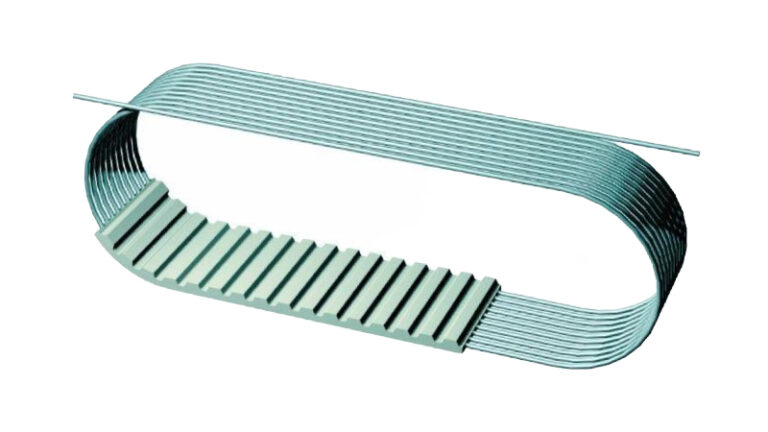
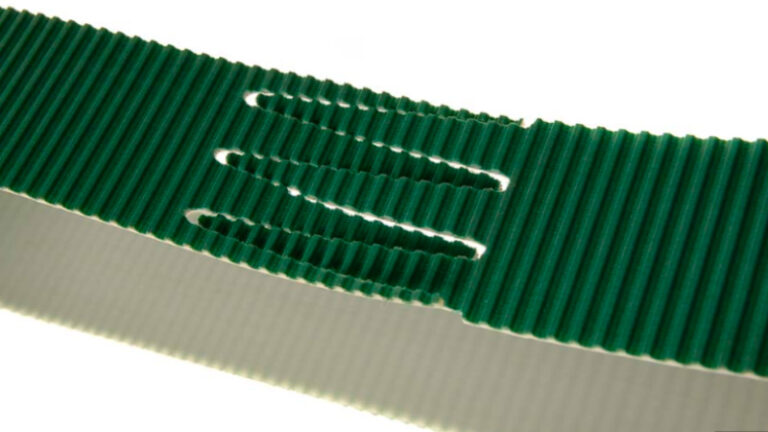
While both belt types may share identical tooth profiles (such as HTD, STD, T, or AT series) and pitch dimensions, their internal cord structure, tensile load capacities, and length limitations differ significantly. This guide breaks down the engineering differences to help you select the exact belt for your application.
Understanding Spliced (Welded/Jointed) Timing Belts
Spliced timing belts—also known as welded, jointed, or vulcanized belts—are manufactured by taking extruded open-ended timing belt stock, cutting it to the required length, and thermally joining the two ends together using a finger-joint welding process.
Manufacturing and Internal Cord Structure:
Finger-Joint Welding: The cut ends of open-stock extrusion are die-cut into interlocking “finger” patterns.
Thermal Fusion: The fingers are placed into a heating mold where thermoplastic polyurethane melts together under controlled pressure and temperature.
Cord Discontinuity: Because open-ended belt stock is cut, the embedded steel or Kevlar (Aramid) tensile cords inside are severed at the joint. There are no continuous tension cords passing through the splice.
Key Advantages:
Virtually Unlimited Lengths: Can be produced to virtually any custom length, from under 1 meter to well over 100 meters.
Cost-Effective Prototyping: Requires no expensive molding tooling, making it economical for low-volume or non-standard center-distance conveyors.
Fast Lead Times: Can be quickly converted from bulk inventory stock for emergency machine repair.
Understanding Truly Seamless (Molded Endless) Timing Belts
Seamless timing belts—often referred to as truly endless, flex, or molded endless belts—are manufactured in a continuous spiral winding or thermoset molding process where no joint or weld exists anywhere along the belt loop.
Manufacturing and Internal Cord Structure:
Continuous Helical Tension Cords: High-tensile steel or Kevlar cords are wound in a continuous, unbroken spiral around a cylindrical mandrel or inside a casting mold before polyurethane or rubber is injected.
Homogeneous Matrix: The elastomer completely encapsulates the unbroken cord bundle, creating a uniform cross-section throughout the entire 360-degree circumference.
Zero Weak Points: With no welded seam, stress distribution remains uniform across every tooth and cord length.
Key Advantages:
Maximum Tensile Load Capacity: Leverages 100% of the allowable cord tensile strength.
High Dynamic Power Transmission: Capable of transmitting high power and torque at elevated speeds (over 3,000 RPM) without risk of fatigue failure at a joint.
Superior Pitch Precision: Maintains exact tooth-to-tooth pitch uniformity across the entire loop, minimizing vibration and positioning error.
Technical Comparison Overview
Tensile Strength Capacity:
Spliced Timing Belts: Approximately 50% of open belt rating
Seamless Timing Belts: 100% of nominal cord rating
Internal Tension Cord:
Spliced Timing Belts: Severed at finger-joint weld
Seamless Timing Belts: Continuous, unbroken helical strand
Length Availability:
Spliced Timing Belts: Highly flexible (1 meter to over 100 meters)
Seamless Timing Belts: Fixed mold sizes (typically up to 15–20 meters)
Max Torque and High Power Capability:
Spliced Timing Belts: Moderate to Low (Primary function: Conveying)
Seamless Timing Belts: High to Extreme (Primary function: Power transmission)
Tooling and Setup Cost:
Spliced Timing Belts: Low (Cut directly from roll stock)
Seamless Timing Belts: Moderate to High (Requires dedicated mold sizes)
Dynamic Speed Limit:
Spliced Timing Belts: Moderate (Under 1,000 RPM recommended)
Seamless Timing Belts: High (Over 3,000 RPM capacity)
Deep Dive: Key Engineering Selection Factors
- Tensile Load and Allowable Tooth Shear
The primary functional distinction is allowable tensile force.
Because the internal tensile cords are cut during the finger-jointing process, the joint in a spliced belt relies entirely on the shear strength of the melted polyurethane matrix between the interlocking fingers. As a design rule of thumb, a spliced timing belt exhibits roughly 50% of the allowable tensile load capacity of an open-ended or truly endless belt.
Choose Spliced Belts if your system is a horizontal material transport conveyor, indexing line, or light-duty positioning axis where belt pull force remains well below 50% of maximum cord capacity.
Choose Seamless Belts if your drive experiences heavy start-stop shock loads, high dynamic acceleration, or direct motor torque transmission where 100% cord integrity is non-negotiable.
- Length Requirements and Flexibility
When machine dimensions demand extremely long center distances, manufacturing constraints dictate the belt choice:
Seamless Belts are restricted by fixed mold circumferences. Producing a custom seamless belt with an obscure length (for example, 13,425 mm) requires dedicated tooling or specialized spiral winding equipment, which can increase unit costs and lead times.
Spliced Belts offer unlimited dimensional flexibility. Roll stock can be extruded, stored, cut to exact millimeter specifications, and thermally welded on demand without tooling investment.
- High-Speed Fatigue and Dynamic Vibration
At high linear belt velocities (greater than 10 m/s), the local stiffening or micro-flexibility mismatch at a welded finger-joint creates cyclic dynamic imbalance as the joint passes over pulleys. Over millions of bending cycles, this localized fatigue can lead to micro-cracking at the root of the weld fingers.
Seamless belts maintain identical flexural rigidity across every millimeter of their length, ensuring silent, vibration-free performance even at high RPMs over small pulley diameters.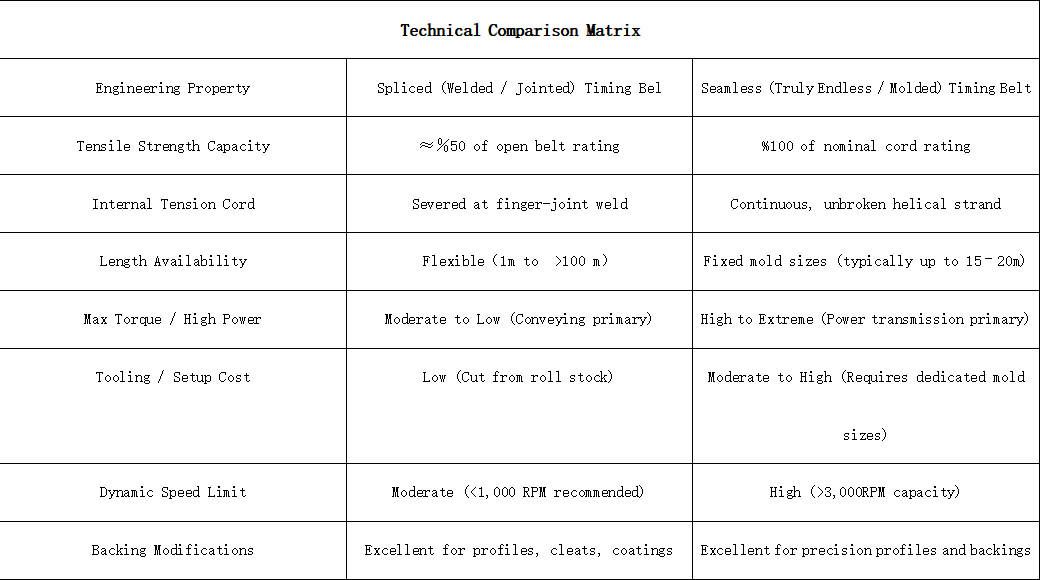
Application Matching Guide
Recommended Applications for Spliced Belts:
Material Handling and Line Conveyors: Pallet transport lines, packaging accumulation tables, and glass/sheet handling systems.
Linear Positioning Belts with Attachments: Belts fitted with welded cleats, profiles, or custom backings (Linatex, Supergrip, PU sponge) where conveying force is the primary duty.
Modular Machine Builds: Equipment requiring non-standard lengths where custom mold creation is cost-prohibitive.
Recommended Applications for Seamless Belts:
High-Torque Synchronous Power Transmission: Connecting motors to main drive shafts, heavy-duty pumps, or CNC machine spindles.
High-Precision Multi-Axis Motion Control: Gantry robotics, pick-and-place systems, and 3D printers requiring low backlash and consistent spring rate.
High-Speed Printing and Converting: Applications requiring extreme speed stability and low angular velocity fluctuation.
Frequently Asked Questions (FAQ)
- How can I visually tell if a timing belt is spliced or seamless?
Inspect the inner tooth surface and outer back cover carefully. A spliced belt will show a subtle zig-zag or V-shaped finger-joint seam across its width where the thermoplastic was melted. A seamless belt will have a completely smooth back and tooth profile without any visible transverse joint lines. - Can a broken timing belt be welded back together in the field?
While portable hot-welding presses exist for field maintenance of polyurethane belts, a re-welded belt will only retain approximately 50% of its original strength (or less if the joint is contaminated). Field welding is suitable as a temporary fix for conveyor lines, but broken high-torque power transmission belts should always be replaced with a new factory-produced endless belt. - Which internal tension cord is best for spliced belts—Steel or Kevlar?
Both steel and Kevlar (Aramid) cords can be welded into spliced belts. Steel cords provide higher longitudinal stiffness and lower stretch, making them standard for indexing conveyors. Kevlar cords offer better resistance to repetitive bending fatigue and are preferred for small pulley diameters or environments requiring non-magnetic properties. - Are seamless timing belts more expensive than spliced belts?
For standard stock sizes, molded seamless belts are cost-effective due to high-volume production. However, for non-standard, custom, or very long lengths, seamless belts can be more expensive due to specialized mandrel tooling, whereas spliced belts remain cost-effective across any custom length.
Precision Timing Belts & Custom Manufacturing Solutions
Selecting between a spliced and a seamless timing belt comes down to evaluating your system’s tensile load requirements, operating speeds, and dimensional constraints.
Dongguan Zhende Machine Equipment Co., Ltd. is a specialized manufacturer of high-precision Timing Belts, PU Timing Belts, Rubber Timing Belts, and CNC-machined Timing Pulleys.
Our engineering team manufactures both high-tensile Seamless (Truly Endless) PU Belts for demanding power transmission applications and custom Spliced (Welded) PU Belts complete with specialized backings (red rubber, Linatex, PU sponge), cleats, perforations, and custom tooth profiles.
Have an unmarked belt or need custom drive engineering assistance? Contact Dongguan Zhende Engineers Today for technical guidance and direct factory quotes.
WhatsApp: +86 18002849592
Email: Liang@zd-transmission.com