
Introduction
Many machine builders mix S5M and 5M timing pulleys by mistake. Both carry a 5-millimeter pitch between adjacent teeth. This shared dimension tricks buyers into thinking they match. Their tooth profiles follow different design standards. Mismatched sets trigger fast wear and sudden machine downtime. Engineers need clear facts to avoid this common error.
Dongguan Zhende Machine Equipment Co., Ltd. masters these two profiles. We supply qualified S5M and HTD 5M pulleys globally.
STD S5M vs HTD 5M Timing Pulleys: Quick 60-Second Comparison
| Feature | 5M (HTD) | S5M (STD / STS / STPD) |
| Pitch | 5.00 mm | 5.00 mm |
| Tooth form | Fully rounded, semi-circular flank | Modified curvilinear, flatter crown, wider root |
| Belt tooth height | ≈ 2.06–2.10 mm | 1.91 mm |
| Belt overall thickness | ≈ 3.8 mm | 3.4 mm (1.49 mm backing + 1.91 mm tooth) |
| Pulley groove depth per side | 0.57 mm | 0.48 mm |
| Outside diameter, 20T | 30.69 mm | 30.87 mm |
| Lowest catalog tooth count | 13T (14T recommended) | 14T |
| Common standard widths | 9, 15, 25 mm | 10, 15, 20, 25 mm |
| Standards / origin | Gates PowerGrip HTD, now an industry-wide profile | JIS B 1856 (ISO 5294) pulleys, JIS K 6372 (ISO 5296-1) belts |
| Typical positioning | Higher torque per width, heavy continuous drives | Lower backlash, quieter and smoother mesh, precision axes |
| Interchangeable? | No | No |
Dongguan Zhende keeps both profiles in ready stock. All dimensions above are strictly inspected before shipment.
What 5M HTD Profile Means
5M belongs to the HTD, or High Torque Drive, tooth family. HTD uses a fully rounded, semi-circular tooth flank shape. The belt tooth height sits near 2.06 to 2.10 millimeters. Total belt thickness measures roughly 3.8 millimeters. Each pulley groove depth reaches 0.57 millimeters per side. This profile spreads contact stress across a long curved surface. It handles continuous heavy loads and shock torque better. Common belt widths include 9 mm, 15 mm and 25 mm. The smallest catalog tooth count starts at 13 teeth. Most designers choose 14 teeth as a safe practical minimum. Conveyor and packaging systems often select HTD 5M. The rounded tooth shape delivers stable high torque output.
Dongguan Zhende manufactures HTD 5M pulleys with CNC centers. We control concentricity for stable heavy-load operation.
What S5M STD Profile Means
S5M falls under STD, also labeled STS or STPD standards. STD stands for Super Torque Drive from Japanese norms. It follows JIS and ISO standards for pulleys and belts. S5M uses a modified curvilinear tooth form. Its tooth crown is flatter with a wider tooth root. Belt tooth height is only 1.91 millimeters. Full belt thickness stays at 3.4 millimeters total. Pulley groove depth reads 0.48 millimeters per side. Minimum tooth count for S5M pulleys is fixed at 14 teeth. Standard available widths are 10 mm, 15 mm, 20 mm and 25 mm. This profile prioritizes low backlash and quiet running. Precision positioning axes are its main application field. CNC and servo equipment frequently adopt S5M timing sets.
Dongguan Zhende S5M pulleys fit precision servo motion systems. We guarantee low backlash for repeated positioning tasks.
Pitch Diameter Matches, Outside Diameter Does Not
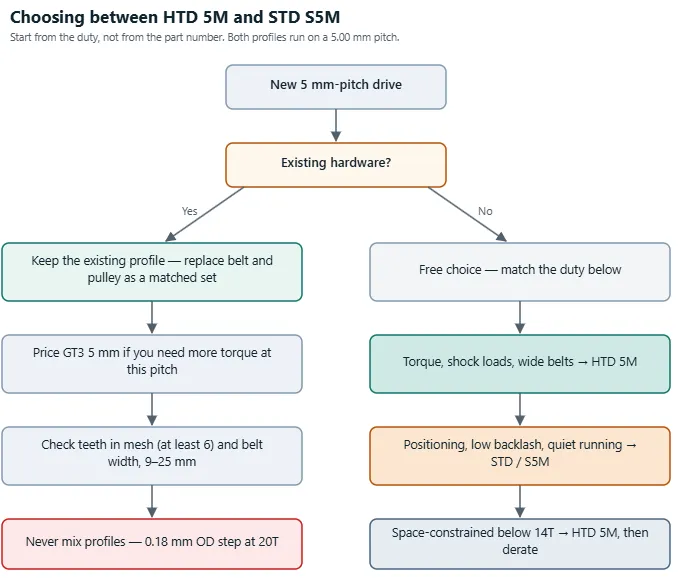
Pitch diameter only depends on pitch and tooth number. The formula PD = (p × z) / π applies to both profiles. A 20-tooth pulley hits a pitch diameter of 31.83 mm. Outside diameter relies on tooth seating depth instead. S5M 20T pulley OD equals 30.87 millimeters. HTD 5M 20T pulley OD equals 30.69 millimeters. The gap stays steady at 0.18 mm for all tooth counts. This small gap can cause clearance issues in tight housings. Flange alignment and belt guiding will shift slightly. No direct drop-in swap works between these two profiles. Designers cannot ignore this tiny dimensional difference.
Dongguan Zhende checks OD one by one for every batch. Our inspection avoids assembly clearance troubles.
Performance Tradeoffs Between Two Profiles
HTD 5M delivers higher torque per unit belt width. Load spreads along a longer arc on each tooth surface. It tolerates sudden torque spikes and heavy continuous work. S5M STD creates lower backlash during motion cycles. The flatter crown creates more repeatable positioning. S5M runs quieter at identical rotating speeds. It reacts poorly to overload and improper belt tension. Tooth damage appears faster under shock loading conditions. At 5mm pitch, the performance gap is relatively narrow. Belt width and meshing teeth often decide final load rating. For extra torque, engineers may check GT2 or GT3 5MR options. GT3 offers up to 25 percent higher load than standard HTD. GT series belts also cannot fit S5M or 5M pulleys.
Dongguan Zhende provides technical selection support free. We help you pick the correct profile for your load needs.
Signs of Mismatched Belt and Pulley
A 5M belt can physically fit onto an S5M pulley. It may run for a short time without obvious failure. Contact changes from full area contact to sharp line contact. Drive side tooth wear speeds up within tens of operating hours. Belt tension drops gradually as the tooth shape wears away. Ratcheting or tooth jumping will happen under working load. Complete tooth shear can stop production without warning. No quick field repair fixes this profile mismatch problem. The full set of belt and two pulleys must be replaced together. Mixing profiles creates hidden risks for automated machinery.
Zhende reminds you not to mix these two profiles. Our engineers help audit existing transmission assemblies.
Practical Ways to Identify Your Existing Profile
First, check the marking printed on the back of the belt. Markings of 5M or HTD confirm the HTD tooth profile. Labels of S5M, STS, STPD or STD confirm STD profile. Second, measure tooth height with a precision caliper. 1.91 mm tooth height points to an S5M belt. 2.06–2.10 mm tooth height points to an HTD 5M belt. Only test clean, unworn teeth for reliable readings. Third, measure pulley OD if you know the tooth count. A 20T pulley at 30.87 mm OD is S5M STD. A 20T pulley at 30.69 mm OD is HTD 5M. Worn pulleys should be measured across groove roots. If readings fall between values, treat the pulley as unknown. Test fit with a sample belt before ordering bulk parts.
Dongguan Zhende supplies sample pulleys for profile verification. Samples support your on-site measurement and validation.
Selection Guide for New Timing Drive Designs
Pick the tooth profile before calculating belt length. All pulleys, belts and flanges follow this core choice. Choose HTD 5M for continuous conveying and heavy drives. Pick S5M STD when positioning repeatability matters most. Noise reduction is another key reason to select S5M. Compare minimum tooth limits for the smaller drive pulley. Keep at least six teeth engaged for stable load transfer. Fewer meshing teeth require a lower load derating factor. Match belt width availability to your selected profile. Verify bore size, keyway and hub dimensions separately. Update spare part lists to avoid mixed-profile stock. A wrong spare part will trigger future unexpected breakdowns.
Dongguan Zhende supports OEM and ODM custom machining. We customise bore, keyway and surface treatment as required.
Closing Summary
S5M and 5M timing pulleys share a 5 mm pitch only. Tooth geometry, groove depth and OD differ completely. They are non-interchangeable under any operating condition. Select HTD 5M for torque and S5M for precision motion. Simple measurement checks help verify installed hardware. Correct profile selection protects machine uptime long term.
Zhende Machine Equipment Co., Ltd. Your trusted precision timing pulley manufacturer .